
Tack & Fit · The Very Best
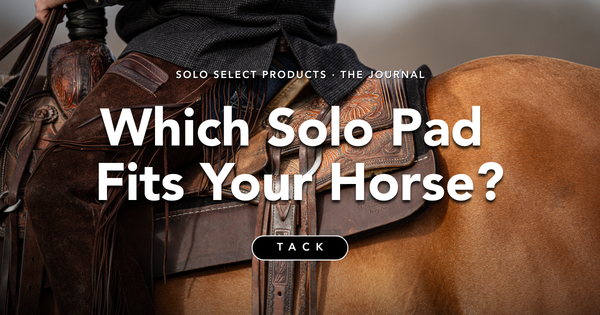
Which Solo Pad Fits Your Horse?
Canvas, contoured felt, or Poron kidney — the right pad isn't the most expensive one. It's the one matched to your horse's back, your discipline, and what the research actually says about pressure.

Every rider eventually asks the same question at the tack shop: does the pad under my saddle really change anything, or is it just there to keep the leather clean?
For decades, that second answer was the assumption. The science now tells a more useful story — and it's the story behind why we build our pads the way we do.
Researchers at the University of Veterinary Medicine in Vienna tested this on sixteen sound horses, comparing gel, leather, foam and reindeer-fur pads under a correctly fitted saddle. Their conclusion was clear: a well-chosen pad can meaningfully reduce the load a horse's back carries — but the material doing the work matters enormously, and a poorly chosen one does nothing at all.
The Two Things Every Good Pad Has to Get Right
1. It has to spread pressure, not just add cushion. A saddle fitter's benchmark for good fit is a large, continuous contact area with force spread evenly and no concentrated hot spots. The pad's job is to help the panels do that. This is exactly what our F10 felt is engineered for — a dense fiber matrix with an 8.0 PSI compression rating and 225 PSI tensile strength that resists packing down and losing that spread over time.
2. It has to respect the spine. Saddles are built with a gullet channel — a deliberate tunnel that keeps pressure off the bony spinous processes and the ligaments running alongside them. This is where a lot of well-meaning pads go wrong.
Dyson and Greve (2016) found that some saddle pads actually add unwanted pressure over the spinous processes when they stretch flat across the spine instead of following the gullet. A pad that "tents" over the midline can undo the very clearance the saddle was designed to provide.
The takeaway isn't "avoid pads." It's to choose a pad that supports the muscles on either side of the spine without loading the spine itself — and one that adds protection without over-stuffing the channel or reducing panel contact.
The Four Solo Pads — and Who Each One Is For
Canvas Work Pad
Our hardest-working everyday pad. A tough canvas top over a pressed-wool-and-fleece build, so it takes the abuse of daily schooling — ride after ride, wash after wash — without breaking down. Soft wool and fleece sit against the coat while the canvas shell shrugs off the wear that flattens cheaper pads by mid-season.
 Canvas Work Pad · $345Click here to shop this item →

Contoured Felt Saddle Pad
Our all-around competition pad, and the one most riders build their kit around. Solid F10 felt cut in a contoured shape that follows the topline instead of fighting it. That dense fiber matrix does the pressure-spreading work the research points to — distributing weight evenly and controlling friction so the saddle stays stable — while wicking heat and sweat away over long sessions. The 3/4" and 1" options let you fine-tune for even panel contact.
 Contoured Felt Pad · $425Click here to shop this item →

Poron Kidney Pad — Felt Bottom
Here we add a second technology on top of the felt. The kidney shape places a 1" layer of Poron® XRD where the horse needs targeted shock absorption, then finishes with an F10 felt bottom for even weight distribution. Poron XRD stays flexible in normal movement but stiffens instantly on impact — engineered to absorb up to 90% of impact energy — in a low-profile form that won't over-fill the gullet or interfere with fit. The felt bottom adds firm, structured, moisture-wicking grip that holds its shape ride after ride.
 Poron Kidney — Felt · $495Click here to shop this item →

Poron Kidney Pad — Fleece Bottom
Same 1" Poron® XRD kidney and the same up-to-90% impact absorption — finished with premium synthetic fleece instead of felt. That swap makes the contact surface plush, cushioned and softer, with breathability and moisture-wicking built in. Unlike cheaper fleece that pills, mats, or flattens, ours holds its loft through repeated washing.
 Poron Kidney — Fleece · $495Click here to shop this item →

Side by Side: Find Your Pad
| Pad | Build | Key Benefit | Best For | Price |
|---|---|---|---|---|
| Canvas Work Pad | Canvas top · pressed wool core · fleece contact | Rugged everyday durability with a soft, breathable surface | Daily schooling, lessons, ranch & colt work | $345 |
| Contoured Felt Pad | Solid F10 felt · contoured · 3/4" or 1" | Even pressure distribution & lasting shape; moisture-wicking | All-around competition in a well-fitting saddle | $425 |
| Poron Kidney — Felt | 1" Poron® XRD kidney + F10 felt bottom | Targeted shock absorption (up to 90%) + firm, structured grip | High-impact disciplines; maximum structure | $495 |
| Poron Kidney — Fleece | 1" Poron® XRD kidney + synthetic fleece bottom | Same up-to-90% absorption + plush, breathable soft contact | Sensitive/thin-skinned horses & warm conditions | $495 |
All Solo pads use premium F10 felt (8.0 PSI compression · 225 PSI tensile strength). Poron® XRD absorption figures are manufacturer-tested and vary with use and testing conditions.
Recommended Studies
- Kotschwar, A. B., Baltacis, A., & Peham, C. (2010). The effects of different saddle pads on forces and pressure distribution beneath a fitting saddle. Equine Veterinary Journal, 42(2), 114–118. doi.org/10.2746/042516409X475382
- Dyson, S., & Greve, L. (2016). Saddles and girths: What is new? The Veterinary Journal, discussion of pad pressure on the spinous processes.
- MacKechnie-Guire, R., Fisher, M., & Pfau, T. (2021). Effect of a half pad on pressure distribution in sitting trot and canter beneath a saddle fitted to industry guidelines. Journal of Equine Veterinary Science, 96, 103307. doi.org/10.1016/j.jevs.2020.103307
- Hawson, L. A., McLean, A. N., & McGreevy, P. D. (2013). A retrospective survey of riders' opinions of the use of saddle pads in horses. Journal of Veterinary Behavior, 8(2), 74–81. doi.org/10.1016/j.jveb.2012.05.004